Food for Thought

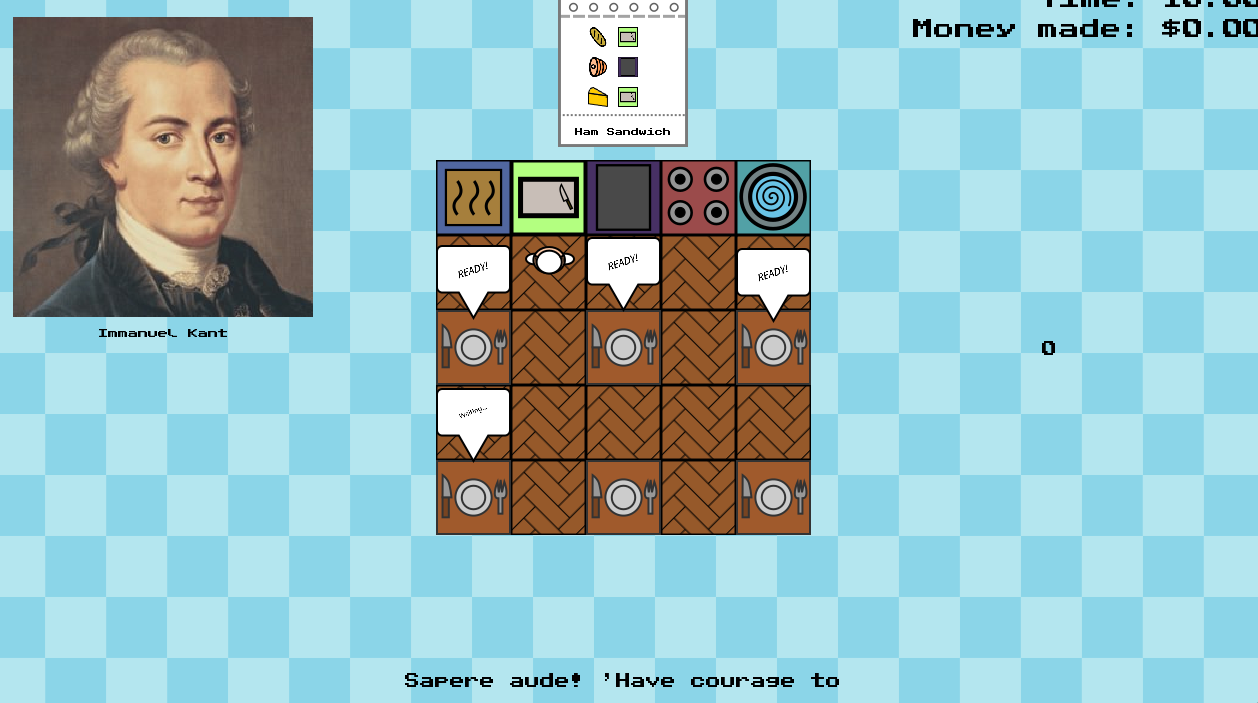
The Idea
Sometime during the fall of 2024, I was biking home from work, and I came up with an idea for a project to work on. It would be a game called "Food for Thought". I wanted to use PyGame, which is a Python library used to make games.
I'm a data scientist at CERL for the U.S. Army Corps of Engineers, and a lot of my work is done in Python. Python was pretty much the first programming language I decided to take a deep dive into, and I had been familiar with third-party libraries like Pandas, PyTorch, Matplotlib, etc.
One day, I happened upon a library called PyGame. It's essentially an SDL2 wrapper which exposes convenient functions for drawing things onto windows, moving things around, and handling user input. I became obsessed with this library and dove into its documentation.
Admitedly, I didn't understand much of what was going on. See, I was still in my undergrad when I discovered PyGame and was still learning the ropes of Python and object-oriented programming in general. For a game design class, I used PyGame to create a game called Mr.Bear's Tavern. It was really cute, and I was proud of what I'd built. I'd even created a little card game about goblins which was the central aspect of the game. But the code was pure spaghetti and it became really hard to extend. I wasn't making use of PyGame's central Sprite class and everything was purely functional and highly coupled. Very poorly organized. But, it was a great learning experience!
Since graduating, I haven't stopped trying to upskill and learn new programming languages and concepts. At the time of writing, I quite literally study programming and CS/DS concepts every day, at work and at home. When I'm not burned out from work, I try working on projects that I hope demonstrate my passion and dedication to building things and reverse engineering complex systems.
Learning
When I started this new project, I created a game design document and outline some important aspects of this game. First, that it would be called Food for Thought because it would be a typing game where the user types out philosophers' quotes to cook food.
I cooked up some simple assets using Inkscape and then got to work on the code. I picked up a book from O'Reilly called Object-Oriented Python and read through it. I'd been exposed to OO concepts like inheritance, encapsulation, and polymorphism before, but I was having a lot of trouble. Let me tell you, this book helped, especially since it uses PyGame as a way of explaning OO.
When reading PyTorch code at work, I'd seen classes inheriting from nn.module and didn't fully understand what was going on. Much like PyTorch with its nn.module, PyGame gives the user a pg.sprite.Sprite class to inherit from. It took a while, but I eventually filled those gaps in my understanding.
The Process
I make it a top-down tile-based game kind of like how the game Overcooked looks. I also drew a lot of inspiration from a Youtuber called Goodgis and from a video he made. Studying his game's repo helped me understand how to organize and structure my game's components.
Most of the time I was making this game, I didn't have a plan. I was just doing it as I went. I mean, it was just I side project I did for fun. I built entire facets of the game that I would eventually end up throwing out. Like an inventory system I made where the user would pull from a limited amount of ingredients and use those to cook.
This went on and on for a really long time. I was also busy with other stuff at the time, like some additional math classes I decided to take after graduating (only cause work paid for it), and trying to enjoy life when I wasn't grinding. But, after trying things out, tinkering, and messing around, I eventually grew bored and made a point to get this game to a "playable" state. The source can be checked out here on my github!
The Future
All in all, this was a great learning experience which had a noticable effect at work. I was able to understand code that was tough to chew at one point. It definitely solidified my understanding on object-oriented programming, which is important for lanugages like C# and Java which rely on objects.
I plan to explore Godot, an open source gamedev engine, and create games within that ecosystem.